If I were to ask any random engineer, who didn’t have management experience, “what does your manager actually do?”, I bet they would say something along the lines of “well… they manage a team of engineers, work with product and design, and ensure we deliver our work.”
That’s a decent description of Engineering Management, but it isn’t the whole picture.
I certainly had no idea about all of the responsibilities of an Engineering Manager before I became one myself. In fact, the role came with several surprises. “What do you mean I’m responsible for this? Doesn’t product management do that?”
What Engineering Management Isn’t
Engineering Management isn’t a promotion. Years ago it might have been, but at most companies, Engineering Managers and Individual Contributors sit on two parallel career ladders. Therefore, switching to Engineering Management isn’t a promotion. It’s a lateral move.
First-line management (the managers who manage a team of individual contributors), is also not going to give you a big salary increase if you’re a Senior Engineer (which can be a pre-requisite).
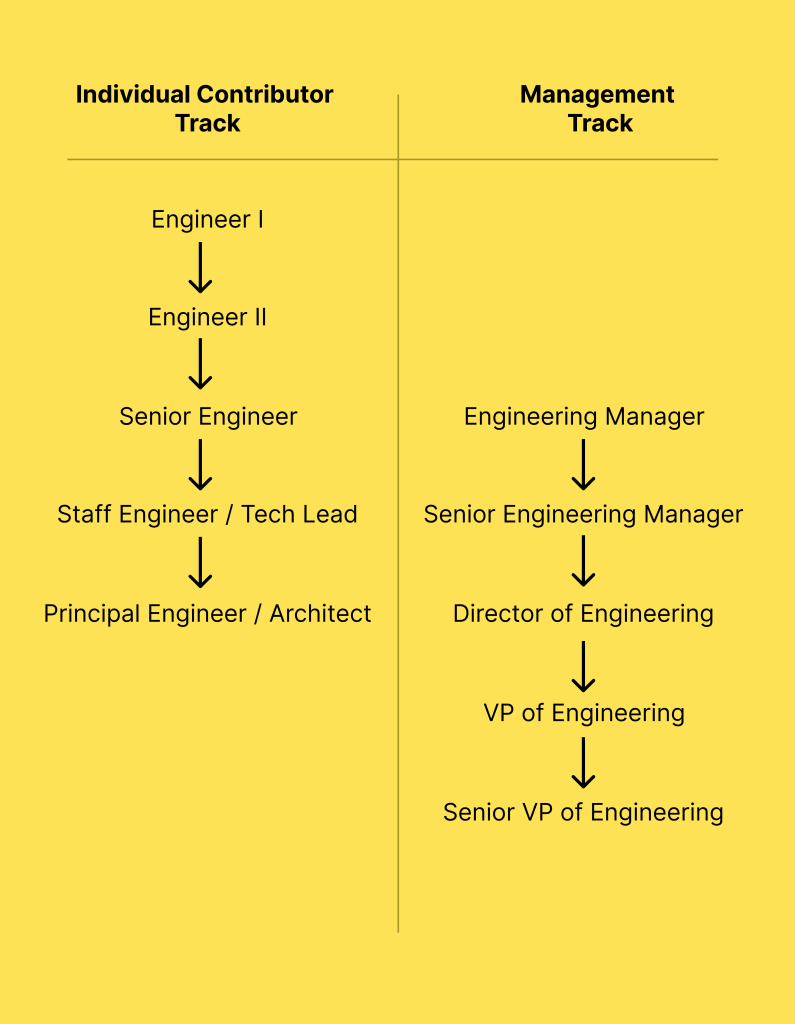
An important caveat – career ladders look different at every company so take this with a grain of salt.
So What Is Engineering Management?
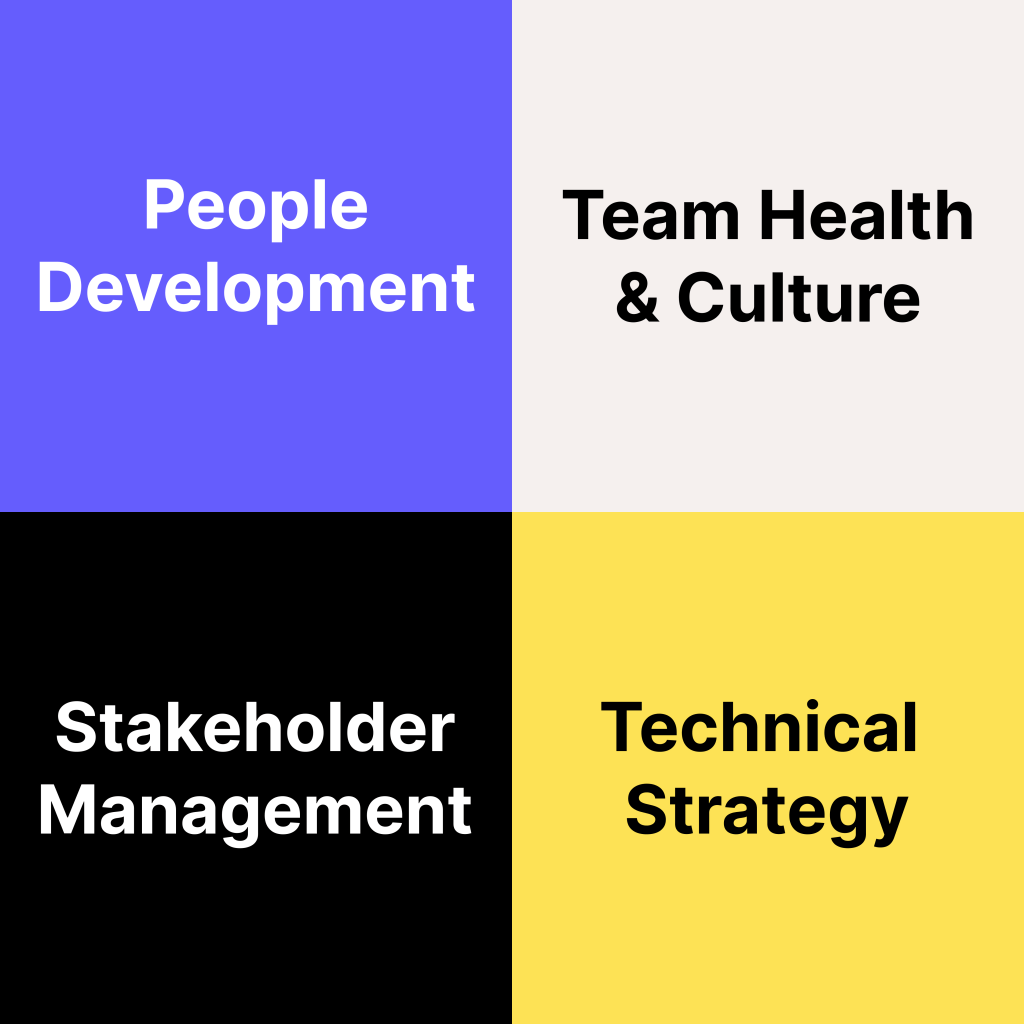
Engineering management is a leadership role that focuses on four core areas:
- People development
- Team health & culture
- Stakeholder management
- Technical strategy
People Development
Developing your team members’ careers is one of the most rewarding parts of being a manager You’ll want to learn about their history and how they got to where they are today. You’ll want to learn about their motivations. What keeps them coming back to work each day? And you’ll want to learn about their values. What do they value as a human being?
Here are a set of activities that you, as a manager, can run with your team during 1:1s to learn about these areas (I won’t dive into all the details of these activities. Those will come in a subsequent post).
The first activity is a career map. Both the team member and manager map out significant milestones in their career histories. This can cover everything from company changes to promotions or even job scope changes.
Once you have the milestones noted, you place them along a vertical axis to indicate how motivated you were during this time.
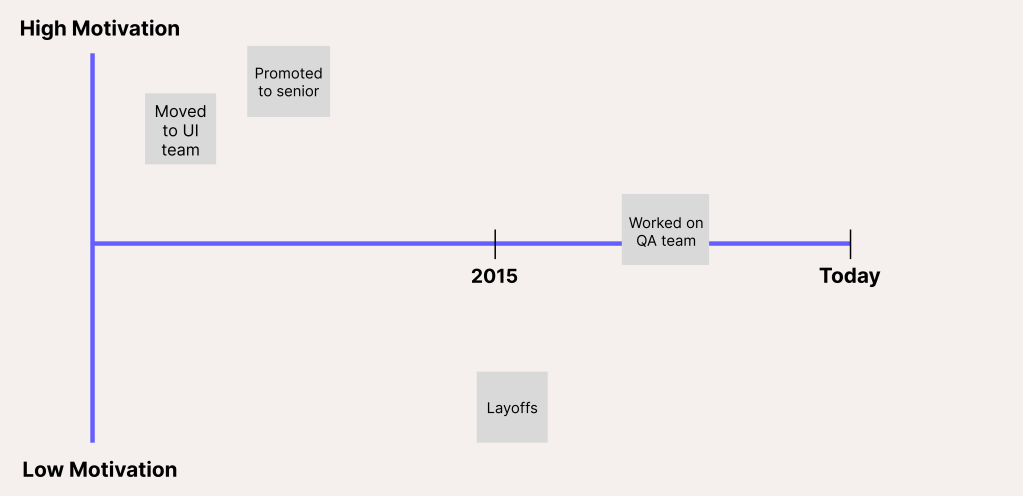
This activity has two great outcomes: it allows you to learn how each of you came to be there today, and it allows you, as their manager, to see what types of roles and circumstances were most motivating and least motivating for them. From there you can discuss why each time in their career had that impact.
Perhaps they realize they’re highly demotivated when working across significant time zones and should focus on projects contained in their geographic location.
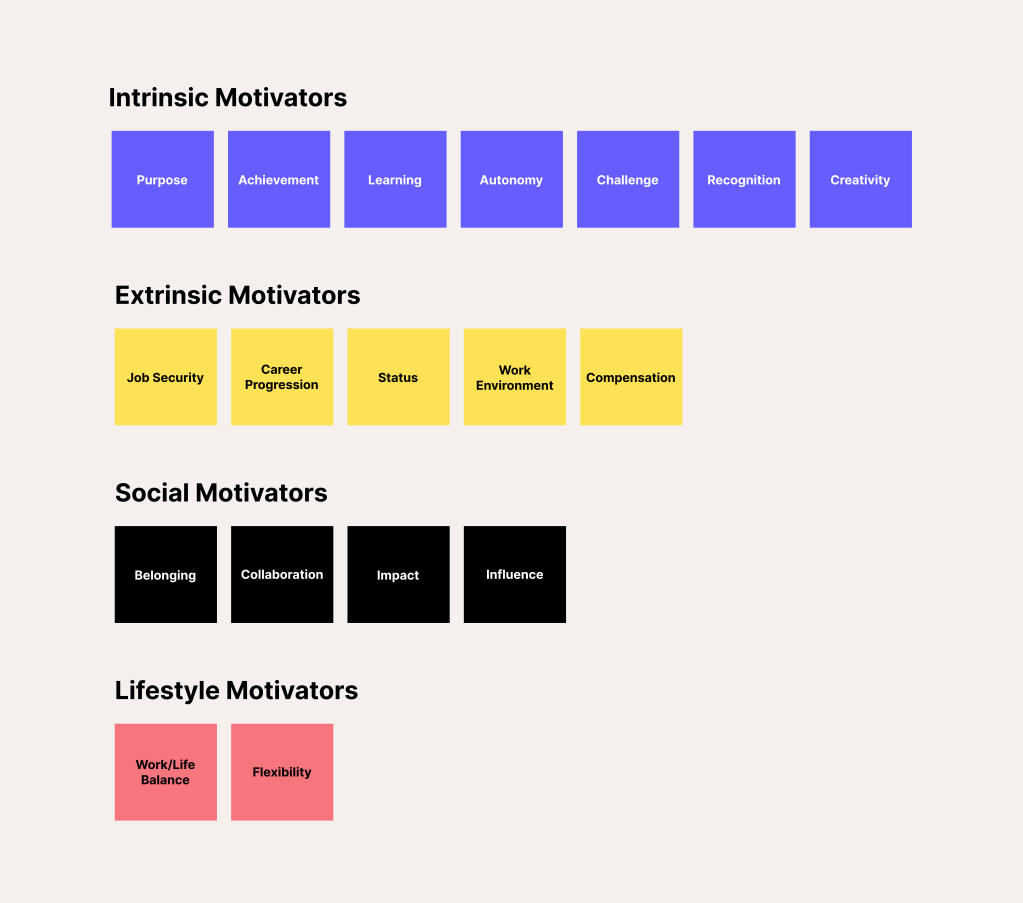
The second activity is a moving motivators exercise. It’s called moving motivators because their motivations should change many times as life changes for them.
In this activity they order a series of cards with different motivators from least motivational to most motivational. The cards include four different types of motivators:
- Intrinsic Motivators
- Extrinsic Motivators
- Social Motivators
- Lifestyle Motivators
As for values, I’ve used Brene Brown’s Dare To Lead values exercise. The team member highlights the top five values they have and we discuss how they show up in their workday.
For example, if someone values family, they likely want a job that supports flexible working hours should they need to take care of a sick child or attend a school event. Or if someone values perseverance, they will likely be frustrated by a colleague who gets stuck and gives up.
I also like to ask folks a few additional questions:
- What are you short-term career ambitions
- What are your long-term career ambitions
- Do you have anything in your personal life that impacts work (i.e. needing to leave to pick up children at 16:00) that you’re comfortable sharing with me?
- How do you like to be managed?
- Think back to the most effective and least effective managers you’ve had; what made them memorable?
Understanding your team members’ ambitions and goals will allow you to match them with the right opportunities for growth and make them feel appreciated by celebrating them in ways that motivate them.
Team Health / Culture
Building a strong team culture requires bringing individual puzzle pieces together to make a cohesive unit. We have to build a cohesive team where folks come from all backgrounds and potentially different geographic locations. It’s not easy!
One great way to do this is with health checks every 3-6 months. I like to do these health checks anonymously so folks can feel more comfortable sharing their true feelings. I ask them to rate their view on the health of the team in several areas including:
- Psychological Safety – I feel safe bringing my whole self to work
- Dependability – I trust my team members to get their jobs done
- Purpose – I understand our team mission and how it fits into the larger organization
- Learning – I feel I am learning/growing on this team
- Speed – We deliver at a good pace
- Technical Debt – I am happy with how we track and manage our technical debt
- Teamwork – I feel we have good collaboration
- Feedback – I find value in the peer-to-peer feedback I receive
- Engagement – I feel engaged in our work
- Continuous Improvement – We are able to challenge and improve our ways of working
Team health can be improved through effective retrospectives. Taking a look at what went well, what could have gone better, and what you should try next time, with clear action items to be followed up on, can have a good impact on morale.
Team culture can be improved through socializing and building trust. With remote teams this is a bit harder but as a manager your job is not to be the one scheduling these social sessions. Instead you need to foster a culture whereby folks take responsibility for building and maintaining trust with one another.
Stakeholder Management
We’ve covered the first half of Engineering Management which is the focus on individuals and the success of your team as a cohesive unit. Now we shift a bit deeper into the role to talk about delivering and managing the work.
Managing stakeholders takes a large portion of your focus as an EM. You’ll interface more with stakeholders during the planning processes, when you need to understand the work being proposed. Some of the questions you might want to ask include:
- What are you asking us to build / what are the deliverables?
- Are there security, privacy, or accessibility concerns?
- Is there a deadline/launch date?
- Is there a build/branch-off date we need to target for this?
- Do we have any dependencies on other teams to deliver this work?
- Do we need designs?
- Do we have any technical limitations or debt that might inhibit our ability to deliver?
- Who are the leadership POCs to keep in the loop?
- How do we want to communicate with stakeholders? (i.e. Slack channel, newsletter, spreadsheet, etc.)
It’s important to understand the goals of your different stakeholders. Tailor your communication based on who you’re speaking with.
A director-level marketing stakeholder doesn’t need to know all the ins-and-outs of how a feature is being built and likely wouldn’t understand all the technicalities anyway. They can always ask for more detail if desired.
Technical Strategy
The last pillar of engineering management is technical strategy. A technical strategy is a document outlining how an organization will use technology to achieve its business goals.
It will examine the challenges that are currently faced by the engineering teams, establish guiding principles that set the direction with which to mitigate these challenges, and outline coherent actions to uphold these guiding principles.
For example one of your challenges might a disorganized and inconsistent user interface. Buttons have different heights and widths on different pages, color values are different across components, and there is no set typography ratio.
A guiding principle might be “Build a cohesive user interface. We aspire to have a cohesive user interface by eliminating inconsistencies in our branding and components.”
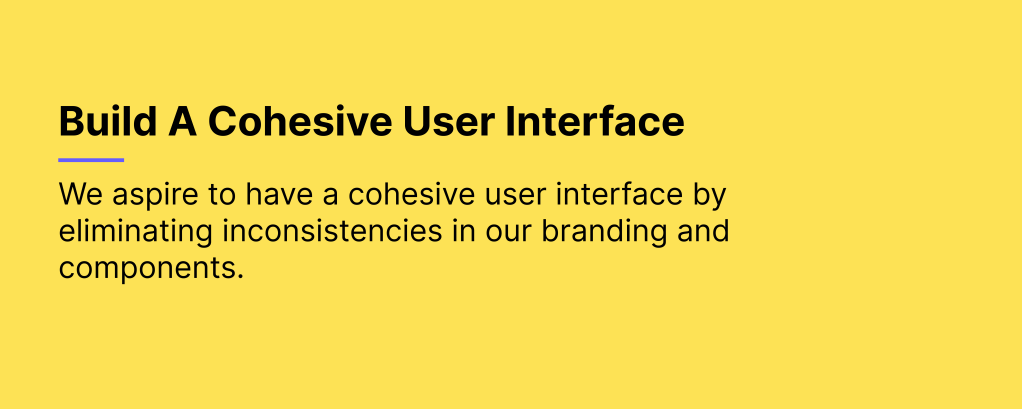
A cohesive action for this guiding principle could be “design and build a design system that unifies our brand identity and provides a set of reusable components.”
The tricky part about technical strategy as a manager is when an important stakeholder is asking you to build a feature that doesn’t adhere to it. You need to be able to have those difficult conversations with leads.
“We’re being asked to build this feature, but they are asking for a completely new button that goes against our technical strategy. This will lead to more inconsistencies in our user interface and codebase. Can we find a solution that utilizes the designs or components we already own?”
Engineering Management is a wonderful role that allows you to combine your technical skills with your human skills. It’s a happy medium for folks like myself who enjoy tech-focused roles but don’t enjoy designing solutions and writing code.
If you want to learn more about Engineering Management, feel free to listen to our Ladybug Podcast episode!
Thanks for reading.


 Commit To Lead
Leave a comment